



When medical care leads to an unexpected injury or a loved one’s condition gets worse, it is natural to wonder whether something went wrong. Was it negligence by a healthcare provider? What the heck happened? So, you ask yourself and your family, what is medical malpractice, legally speaking?
In Michigan, medical malpractice generally occurs when a healthcare professional fails to meet the accepted standard of care and that failure causes injury or harm to a patient. A poor outcome by itself does not necessarily mean malpractice occurred, it could be a known risk of surgery or treatment. There must be evidence that the care provided fell below the applicable standard and that this failure caused the patient’s injury. Understanding that distinction is an important first step for patients and families trying to make sense of what happened.
The Four Elements of a Medical Malpractice Claim
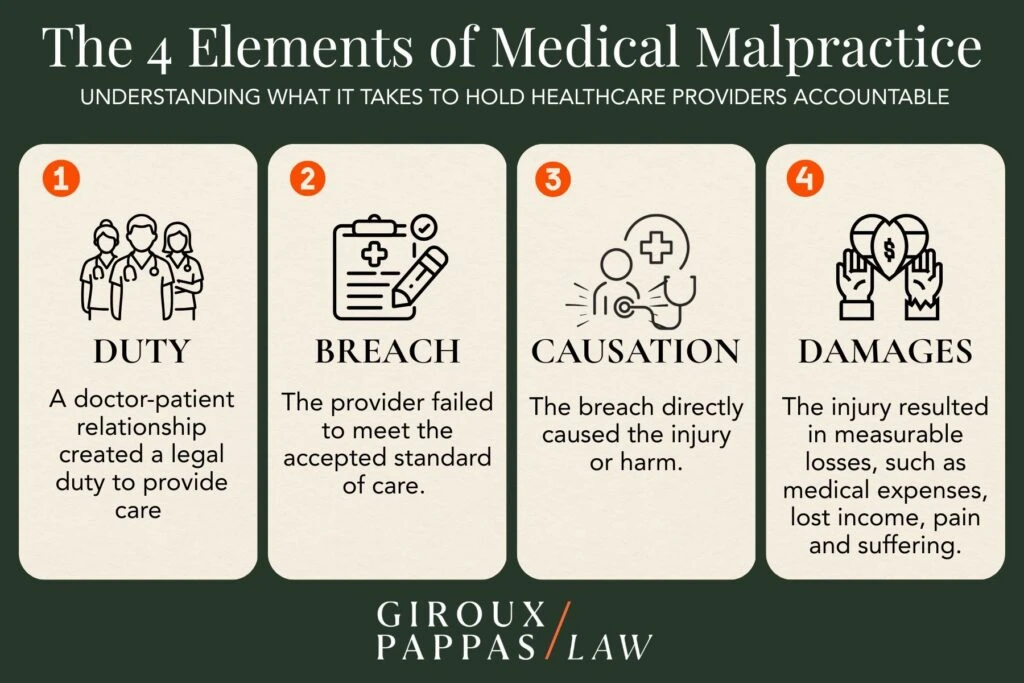
Medical malpractice cases are often medically and legally complex. Although every situation is different, a claim generally involves four basic elements: duty of care, breach of the standard of care, causation, and damages.
A bad medical outcome, by itself, is not medical malpractice. The central questions are whether the applicable standard of care was breached and whether that breach caused harm.
1. Duty of Care
First, you have to show that the healthcare provider actually owed you a professional duty of care. In most cases, this simply means proving a doctor-patient relationship existed—which can be as straightforward as showing an appointment confirmation or a medical bill. Once that relationship is established, the provider has a legal obligation to deliver care that meets accepted professional standards.
2. Breach of the Standard of Care
The next question is whether the healthcare provider met the appropriate standard of care.
The standard of care as stated in Michigan’s Compiled Laws, MCL – Section 600.2912a is not based simply on whether another doctor might have made a different decision. Medicine often involves judgment, and reasonable healthcare professionals may choose different approaches. Rather it examines whether the care provided met the level of care expected of a reasonably competent healthcare professional under the same or similar conditions.
If a provider’s actions or omissions fall below that standard, there may have been a breach. This distinction is important when considering whether medical negligence occurred in the hospital or other medical facility
3. Causation
Causation is the connection between what the healthcare provider did and the client’s injury. This sounds simple but it can be one of the most complicated parts of a medical malpractice case to establish.
For example, a patient may already have been seriously ill or had a pre-existing condition before the alleged error occurred. The question may then become whether the provider’s actions caused a new injury, worsened the patient’s condition, delayed recovery, or reduced the patient’s chance of a better outcome.
Medical experts are often needed to evaluate both the care that was provided and the relationship between that care and the resulting injury.
4. Damages
Finally, the patient must have suffered damages as a result of the malpractice. Damages may include additional medical expenses, lost income, loss of earning capacity, pain and suffering, disability, or other losses resulting from the injury. This is all unique to each case. For instance, in cases involving a patient’s death, surviving family members may have additional claims and damages available under Michigan law.
Common Types of Medical Malpractice
Medical malpractice can happen in many different healthcare settings, including hospitals, doctor offices, surgical offices, nursing homes, doctors’ offices, pharmacies, and other health care establishments. Here are some of the most common ways that medical malpractice occurs:
- Medication mistakes. These cases can be a result of prescribing the wrong drug or medication, giving a higher or lower than necessary dosage, failing to sense a dangerous drug interaction, or failing to consider a patient’s medical history or allergies.
- Birth injuries. Medical negligence during pregnancy, labor, delivery, or newborn care may involve failure to sense a noxious signal from the unborn child, a delay in necessary interventions, or any other departure from then-caliber standard of care.
- Failure to diagnose or delayed diagnosis. This happens when a doctor misses key symptoms, fails to order necessary tests, misinterprets lab results, or delays making a timely diagnosis. The main question here is whether getting an accurate diagnosis earlier would have changed the course of treatment or improved the outcome. It’s a widespread issue: a 2023 Johns Hopkins study estimated that diagnostic errors lead to nearly 795,000 deaths or permanent disabilities in the U.S. every year.
- Surgical errors. A medical negligence claim may involve a mistake by the surgical team, improper or careless surgical technique, damage to surrounding tissue or organs, failure to sense a complication, or failure to adequately monitor a patient after surgery.
- Anesthesia errors. Administering anesthesia requires careful planning, dosing, and continuous patient monitoring. Mistakes—like failing to notice changes in vital signs or reacting too slowly when a patient’s condition shifts—can lead to devastating consequences. Learn more about anesthesia malpractice claims.
- Medication mistakes. These cases can be a result of prescribing the wrong drug or medication, giving a higher or lower than necessary dosage, failing to sense a dangerous drug interaction, or failing to consider a patient’s medical history or allergies.
- Birth injuries. Errors during pregnancy, labor, delivery, or neonatal care often involve missing signs of fetal distress, delaying necessary emergency procedures, or otherwise failing to provide standard medical care during critical moments.
It is important to note that not every medical complication or poor result amounts to malpractice. Each case requires a thorough review of medical records to determine whether standard practices were breached and directly caused harm.
Medical Malpractice Rules and Deadlines in Michigan
Michigan has specific laws governing medical malpractice claims. These requirements are one reason it can be important to have a potential claim evaluated promptly.
Michigan’s 182-Day Notice of Intent
Before filing most medical malpractice lawsuits in Michigan, a claimant generally must provide the healthcare professional or facility with a written Notice of Intent to File a Claim.
This notice generally must be provided at least 182 days before the lawsuit is filed and must contain specific information about the claim.
The Notice of Intent to file is more than a simple letter informing a provider that a lawsuit may be coming. It must include the factual basis for the claim and details about the standard of practice or care that was the proximate cause of the injury. Read more about the Notice of Intent to File a medical Malpractice claim
Affidavit of Merit
Michigan medical malpractice cases also generally require an affidavit of merit when the lawsuit is filed.
Under Michigan Law MCL 600.2912d, the plaintiff’s attorney must seek the opinion and a signed affidavit by a healthcare professional who the attorney believes meets Michigan’s requirements as an expert witness. This expert witness and the affidavit addresses issues including the applicable standard of care, how that standard may have been breached, the steps that should have been taken and how the breach caused an alleged injury to the client.
This step of requiring an affidavit of merit illustrates why medical malpractice claims often require substantial investigation and expert review before a lawsuit is filed.
Michigan’s Medical Malpractice Statute of Limitations
Michigan law also places time limits on medical malpractice claims.
Under MCL 600.5805, the general statute of limitations for a medical malpractice action is two years. However, determining when that period begins and whether an exception or other provision applies can be complicated.
The Notice of Intent requirements can also affect the timing of a case. In some circumstances, additional rules may apply, including those involving when an injury was discovered, if the injured person is a minor, or other specific situations.
Because missing a legal deadline can prevent a claim from moving forward, someone who suspects medical malpractice should not assume they have a full two years to begin investigating the case.
For a broader explanation, read The Basics of Medical Malpractice in Michigan
Frequently Asked Questions About Medical Malpractice
Is a bad medical outcome the same as malpractice?
No. A bad result or unexpected complication does not automatically establish medical malpractice. Generally, there must be evidence that a healthcare provider breached the applicable standard of care and that the breach caused injury or harm.
How do i prove medical malpractice in Michigan?
A medical malpractice claim generally requires evidence establishing duty, a breach of the applicable standard of care, causation, and damages. Because determining the standard of care and causation usually involves specialized medical knowledge, qualified medical experts frequently play an important role in evaluating and pursuing these claims.
Michigan also generally requires an affidavit of merit from a qualified healthcare professional when a medical malpractice lawsuit is filed. It is often recommended that a person who is injured get a second opinion.
How long do I have to file a medical malpractice lawsuit in Michigan?
Michigan generally has a two-year statute of limitations for medical malpractice claims. However, other rules and exceptions can affect the deadline, and Michigan’s 182-day Notice of Intent requirement also affects the filing process.
For that reason, it is important not to calculate a filing deadline based solely on the date of treatment without considering the circumstances of the individual case.
What is the average medical malpractice settlement?
There is no single meaningful “average” settlement that can predict the value of an individual medical malpractice case.
The potential value depends on many factors, including the severity and permanence of the injury, medical expenses, lost income and earning capacity, future care needs, pain and suffering, the strength of the medical evidence, and the effect the injury has had on the patient’s life.
Results vary substantially from case to case, and past results do not guarantee a particular outcome.
Do I need a lawyer to file a medical malpractice claim in Michigan?
It is highly recommended that you engage a medical malpractice attorney. Medical malpractice cases involve specialized procedural and evidentiary requirements, including the Notice of Intent, affidavit of merit, expert-witness requirements, and filing deadlines.
An experienced medical malpractice attorney can obtain and review medical records, consult appropriate medical experts, evaluate whether the evidence supports a claim, and make sure Michigan’s procedural requirements are addressed.
Talk to a Michigan Medical Malpractice Lawyer
If you are trying to determine whether an injury may have resulted from medical malpractice, the first step is understanding what happened and whether the medical evidence supports a claim. The Michigan medical malpractice lawyers at Giroux Pappas Law can investigate complex medical malpractice cases throughout Michigan. Our attorneys review the medical history and records and work with qualified medical experts to evaluate the care that was provided. We have the resources needed for complex case investigation.
It costs you nothing for us to begin an investigation and take on your case. Giroux Pappas, like all personal injury law firms in Michigan, works on a contingency basis. This means we do not recover a fee unless a settlement or verdict is reached.
You can review our real case results and hear from our clients by clicking on the links below:
There is no fee unless we recover for you. To discuss a potential claim, contact us for a complimentary review.