
Search Post
Categories
Recent Posts
- Detroit Ambulance Crash Raises Legal Questions
- Michigan Senate Bill 245: Why It Matters to Injured Policyholders—and Why I Support It
- Katie Muhleck Named December Exceptional Educator
- Bob Giroux Named to Michigan Lawyers Weekly Hall of Fame
- Giroux Pappas Honors Jesse Heckman as Exceptional Educator of the Month
Detroit Ambulance Crash Raises Legal Questions

Who Is At Fault in a Car Accident Involving an Emergency Vehicle?
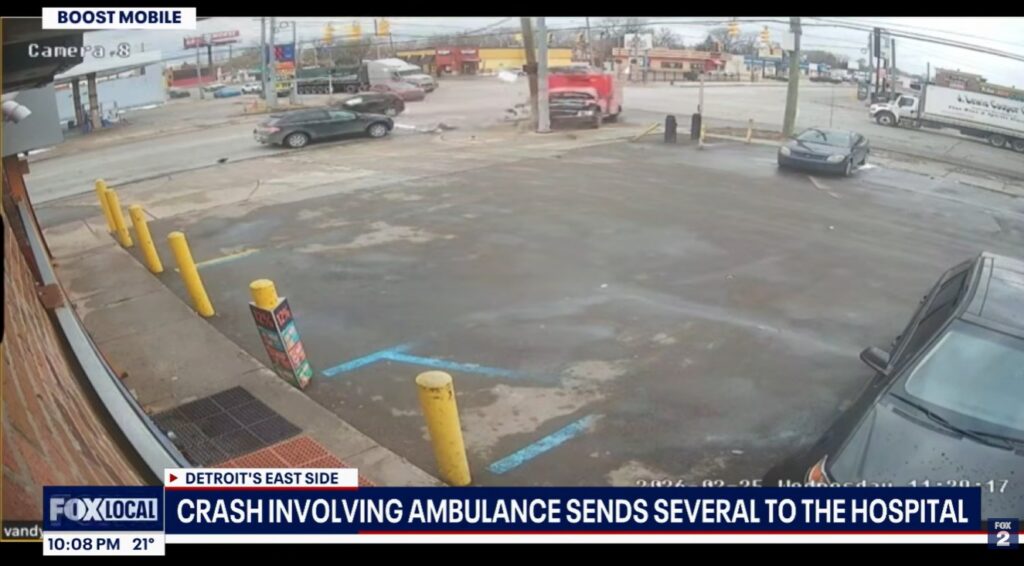
A serious car accident occurred Wednesday in Detroit when an ambulance, responding to a call with its lights and sirens activated, entered an intersection against a red light and collided with a car that was proceeding through on a green light. The accident happened at 7 Mile Road and Van Dyke.
According to MLive, four people were injured in the crash — the driver of the car and three fire department employees who were inside the ambulance. There was no patient in the vehicle at the time. All four individuals were taken to the hospital and later released. The ambulance was reportedly in route to an emergency call.
Fox News posted a video of the accident (Watch Here), showing the ambulance entering the intersection before striking the SUV.
This type of ambulance crash raises an important legal question: Who Is At Fault When an Ambulance Runs a Red Light during an emergency call?
We are all taught to yield to oncoming emergency vehicles when we see flashing lights and hear sirens but does that mean emergency vehicles can proceed through intersections without also yielding to traffic?
The answer is no.
Lessons From a Real Ambulance Intersection Crash
I recently handled a similar case in which an ambulance entered a busy intersection on a red light and caused a serious crash with our client’s vehicle who was proceeding through the intersection on a green light. One of the scene witnesses noted that the ambulance did not give ample time for traffic to observe the ambulance before entering the intersection. Turning on the lights and sirens does not absolve the operator of an emergency vehicle, in this case an ambulance, from exercising ordinary care and caution. The ambulance operator cannot simply activate its lights and sirens and barrel into a busy intersection with disregard for the safety of other motorists (and the patients they are transporting as well).
Who Is At Fault in an Ambulance Crash in Michigan?
In Michigan, an ambulance may go through a read light during an emergency call, but it must slow down and operate with “due regard” for the safety of others. If an ambulance enters a intersection without ensuring it is clear and causes a car accident, it may still be legally responsible
What Michigan Law Actually Says About Emergency Vehicles
There is a common misconception that emergency vehicles — ambulances, fire trucks, and police cars — have an absolute right of way once their lights and sirens are activated. Michigan law makes clear that this is not the case.
Two key statutes address how emergency vehicles must operate in these situations and they state in relevant part:
MCL 257.653(2): Immediate approach of authorized emergency vehicle; duty of driver of another vehicle; duty of streetcar operator; violation as civil infraction.
(2) This section does not relieve the driver of an authorized emergency vehicle from the duty to drive with due regard for the safety of persons using the highway.
This language is critical.
Even when an emergency vehicle is responding to a call, the driver still has an ongoing legal duty to operate the vehicle with “due regard” for others on the road.
“Due regard” can include:
- Taking into account traffic conditions
- Considering visibility and obstructions
- Accounting for pedestrian presence
- Anticipating how other drivers may reasonably react
- Avoiding unnecessary risks
The statute specifically prevents emergency drivers from claiming immunity simply because their lights and sirens were activated. The privilege to respond quickly does not eliminate the obligation to act reasonably under the circumstances.
Emergency vehicles also have specific duties under the following statute when approaching and entering an intersection:
Michigan Vehicle Code: Red Lights and Required Slowdowns
The Michigan Vehicle code MCL 257.603(3)(b) states that an emergency vehicle may, “proceed past a red or stop signal or stop sign, but only after slowing down as may be necessary for safe operation.”
This statute grants emergency vehicles limited privileges — but those privileges are conditional. Yes, an ambulance may proceed through a red light. But the law explicitly requires that it slow down as may be necessary for safe operation. In practice, this can be:
- The driver must reduce speed sufficiently to assess cross traffic
- The intersection must be visually cleared before entry
- The driver must ensure other motorists have time to perceive and react
- The maneuver must be reasonable under the circumstances
If an ambulance enters an intersection at a high rate of speed without ensuring it is clear, that conduct may violate the statute — even if lights and sirens were activated. The law balances urgency with safety. Speed may be permitted in certain circumstances but negligence is not.
How Fault Is Evaluated in an Ambulance Crash
When a serious ambulance crash occurs, investigators examine:
- Whether lights and sirens were activated
- Whether the ambulance slowed before entering the intersection
- Sightlines and obstructions
- Traffic flow and signal timing
- Witness testimony
- Video evidence
- Event data recorders
The key question is often whether the emergency driver exercised “due regard” and slowed as necessary for safe operation. Emergency vehicles do not have absolute immunity simply because they were responding to a call.
Government Vehicle Accidents Require Experience
Car accident cases involving ambulances or other government vehicles can present additional legal hurdles, including governmental immunity defenses and strict notice requirements. These cases require careful investigation and a clear understanding of how Michigan statutes apply to real-world crashes.
A Good Reminder: Your Duty as a Driver Of A Vehicle
According to MCL-Section 257.653:
“the driver of another vehicle shall yield the right of way and shall immediately drive to a position parallel to and as close as possible to the right-hand edge or curb of the roadway, clear of an intersection, and shall stop and remain in that position until the authorized emergency vehicle has passed, except when otherwise directed by a police officer.”
Injured in an Ambulance Crash? Know Your Rights.
Government vehicle cases move quickly. Evidence can disappear. Deadlines can come up quickly. If you have questions about a car accident involving an emergency vehicle, speak with an experienced Michigan attorney as soon as possible.
If you or someone you know has been injured in a car accident involving an ambulance or other government vehicle, it is important to understand your rights. We have experience handling these cases and know how to navigate the legal issues they present. If you have questions, we are here to help. Call 248.531.8665